One-step pieces
Learn the pieces. Practise thinking in steps.
Beginner-friendly English with original Gothic kanji pieces on every diagram. The pointed tip faces up (toward the opponent). Learn all eight piece types together today, then keep this page or the 4-page moves PDF open during your first game. You do not need perfect recall before you start playing. Use the board as a place to notice, compare and explain.
Orientation: Point of each piece faces the opponent.
Capture: land on an enemy piece (same square).
Sliders (Lance, Bishop, Rook and their promotions) cannot jump — only the Knight jumps.
Capture: land on an enemy piece (same square).
Sliders (Lance, Bishop, Rook and their promotions) cannot jump — only the Knight jumps.
Before you move
A simple pause turns a move diagram into a thinking exercise.
- 1 · Observe
What can this piece do from its current square?
- 2 · Compare
Which legal choices are available, and what changes after each one?
- 3 · Predict
What might the opponent do next?
- 4 · Explain
Say why you chose the move, then review what happened.
Piece starts here
Can move / capture
Knight jump
Cannot go
See all 8 at a glance Start a first game Move guide (A4) Promoted moves
All eight piece types at a glance
Take in the whole movement system first. Each side starts with 20 pieces; eight movement patterns are enough to begin.
Sliding pieces
The jumper
Only the Knight jumps over other pieces. Lance, Bishop, and Rook stop when blocked.
That is enough to begin. Set up all 40 pieces, keep the diagrams open, and correct moves together as you play.
Start your first game
Detailed move diagrams
Use these as an open-book reference during play. Letter codes (K, G, …) are for English notes; the board uses the wood pieces.

King · K
王将 / 玉将 · does not promote
One square in any direction (like a chess King). If your King is checkmated, you lose. Traditional sets use 王 for one side and 玉 for the other — same moves.

Gold General · G
金将 · does not promote
Like a King, but not diagonally backward. Excellent defender near the King. Never flip a Gold — it has no promoted side.

Silver General · S
銀将 · promotes → +Silver 全 (Gold moves)
Forward, diagonal forward, and diagonal back. Not sideways or straight back. More flexible for attacking than Gold; promotes to Gold-style moves.

Knight · N
桂馬 · only jumper · promotes → +Knight 圭 (Gold moves)
★
★
Jumps two forward and one sideways — forward only. The only piece that jumps over others. Promotes to Gold-style moves.

Lance · L
香車 · forward slide · promotes → +Lance 杏 (Gold moves)
Any number of empty squares straight forward only — like a half-Rook. Not side, diagonal, or back. Cannot jump. Promotes to Gold-style moves.

Bishop · B
角行 · promotes → Horse 馬
Any number of empty squares diagonally. Cannot jump. Long-range attacker. Promotes to the powerful Horse.
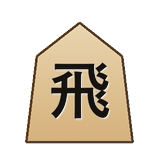
Rook · R
飛車 · promotes → Dragon 龍
Any number of empty squares in a + shape (rank and file). Cannot jump. Often the strongest unpromoted piece. Promotes to the Dragon.

Pawn · P
歩兵 · promotes → Tokin と (Gold moves)
One square straight forward. Captures the same way (not diagonal like chess). Nine per side. Promotes to Tokin — one of the best bargains in shogi.
Promoted pieces — how they move
When a piece promotes, flip it to show the promoted face (paper sets: glue the promoted kanji on the back). Promotion can happen when the piece moves into, out of, or inside the opponent’s last three ranks (the “promotion zone”). King and Gold never promote.
Remember two patterns: Rook becomes Dragon; Bishop becomes Horse. Silver, Knight, Lance, and Pawn all gain the Gold’s movement pattern.
Must promote: If a Pawn, Lance, or Knight would have no legal move next turn without promoting
(e.g. Pawn reaching the last rank), it must promote when the rules allow.
Other promotions are a choice — often you still promote because the new moves are stronger.
→ Dragon
→
Dragon
→ Horse
→
Horse
→ +Silver
→
+Silver
→ +Knight
→
+Knight
→ +Lance
→
+Lance
→ Tokin
Tokin
Major promotions (unique moves)
Dragon · +R
龍王 · promoted Rook
Rook power + one-step diagonal (the four corner-adjacent squares). Keeps the long + slides. Often the strongest piece on the board — great for mating nets.
Cross of dots = Rook slides; the four diagonal neighbors = extra Dragon steps only (not long diagonal slides).
Horse · +B
龍馬 · promoted Bishop
Bishop power + one step orthogonally (forward, back, left, right — one square only). Keeps the long diagonals. Excellent defense and attack.
Long diagonal dots = Bishop slides; the four orthogonal neighbors = extra Horse steps (not long Rook slides).
Gold-style promotions (same moves as Gold)
Promoted Silver, Knight, Lance, and Tokin (promoted Pawn) all move exactly like a Gold — forward, sideways, straight back, and diagonally forward; not diagonally back. They keep their promoted look so you know what they were before capture.
Tokin · +P
と金 · promoted Pawn
Moves like Gold. A promoted Pawn is often better than a Gold in hand because if captured it returns as a plain Pawn. Famous classroom tip: “Tokin is a Gold that cost only a Pawn.”
Promoted Silver · +S
成銀 · 全 · Gold moves
Moves like Gold (gains sideways and straight back; loses the Silver’s diagonal-back-only pattern). If captured, the opponent gets a Silver in hand — not a Gold.
Promoted Knight · +N
成桂 · 圭 · Gold moves
Moves like Gold — no more jumping. Useful near the enemy King after a Knight reaches the promotion zone. Captured → Knight returns to hand.
Promoted Lance · +L
成香 · 杏 · Gold moves
Moves like Gold — no more long forward slide. Promoted Lances often sit in the enemy camp as sturdy Gold-like attackers. Captured → Lance returns to hand.
| Unpromoted | Promoted face | New moves | If captured… |
|---|---|---|---|
| Rook 飛 | Dragon 龍 | Rook + one diagonal step | Opponent gets a Rook |
| Bishop 角 | Horse 馬 | Bishop + one orthogonal step | Opponent gets a Bishop |
| Silver 銀 | +Silver 全 | Same as Gold | Opponent gets a Silver |
| Knight 桂 | +Knight 圭 | Same as Gold | Opponent gets a Knight |
| Lance 香 | +Lance 杏 | Same as Gold | Opponent gets a Lance |
| Pawn 歩 | Tokin と | Same as Gold | Opponent gets a Pawn |
| King / Gold | — | Never promote | — |
Drops (the shogi twist)
How drops work
- Capture an enemy piece → it goes to your hand.
- On a later turn, instead of moving a piece on the board, you may drop a hand piece onto any empty square (with a few limits).
- Dropped pieces always start unpromoted, even if they were promoted when captured.
- Tip still faces the opponent after the drop.
Why drops matter
Material is not “gone forever” as it is in chess. A captured Pawn can come back as a drop check, so your hand remains part of every plan.
Full illegal-drop details are under Important rules. First lesson: capture → hand → drop on empty square is enough.
Starting setup (from your seat)
Back rank: Lance · Knight · Silver · Gold · King · Gold · Silver · Knight · Lance
Middle rank: Bishop on your left · Rook on your right
Front rank: nine Pawns
Mnemonic: “Bishop left, Rook right” from your own seat. Both players use that relative layout.
Quick vocabulary
- Sente — Black, moves first
- Gote — White, moves second
- File — column · Rank — row
- Hand — captured pieces you can drop
- Promotion zone — opponent’s last 3 ranks
Important rules and illegal moves
Start with the first group. Keep the other groups nearby when a question comes up in a full game.
Three checks before you move: Is my King safe? Is the move legal for this piece? If I am dropping a piece, does it obey the drop limits?
Rules for a first game
Goal: checkmate
You win by putting the opponent’s King in checkmate: the King is attacked and there is no legal way to escape, capture the attacker, or block the check.
Keep your King safe
You may not leave your own King in check, ignore a check, or move the King onto a square attacked by an enemy piece. A move that does this is illegal.
Capture, then drop
A captured piece goes to your hand. On a later turn you may drop it on an empty square, always unpromoted. The drop limits below still apply.
Promotion has limits
Pawn, Lance and Knight must promote when they would otherwise have no legal move: Pawn or Lance on the last rank, or Knight on either of the last two ranks.
Common drop restrictions
Nifu — two Pawns
You may not place a second unpromoted Pawn on a file that already contains your unpromoted Pawn. A promoted Pawn (Tokin) does not count. This includes a Pawn drop.
No dead drops
You may not drop, or move an unpromoted Pawn or Lance to the last rank, or an unpromoted Knight to either of the last two ranks, where it would have no legal move next turn.
Uchifu-zume — Pawn-drop mate
You may not checkmate by dropping a Pawn. A Pawn drop that gives check is legal when the opponent still has a legal reply. A Pawn already on the board may give mate.
What happens after a foul?
In an official game, a listed illegal move normally loses immediately. In a casual or online game, follow that service’s rules and ask for a take-back only if everyone agrees.
Advanced game endings
Sennichite — repetition
When the same board position, pieces in hand and side to move occur four times, the game is usually replayed with the colours reversed. This is called sennichite.
Continuous-check repetition
If one player creates that repetition by giving check every time, it is not a draw: the player giving the continuous checks loses.
Jishogi — entering-king endings
When both Kings enter the opponent’s camp and neither side can realistically force mate, a tournament or platform may use a special counting or declaration rule. Check the event’s details.
Rules can vary by event
Official tournaments, clubs and online services can add time controls or detailed procedures. The core rules above are a safe starting point; always follow the organiser’s current rules.
Teaching order: goal, King safety, moves, capture and drops come first. Add nifu, dead drops and Pawn-drop mate as soon as students start using a full set or an online board.
Start a first game Mate-in-1 puzzles Chess comparison Explore shogi across Asia